Munchkin Cat
Breed Profile and Facts
In the feline world, the Munchkin Cat is considered a relatively new cat breed.
This adorable dwarf cat is characterized by its very short legs, a trait that results from a natural mutation.
Man played no part in the 'creation' of the short legs, but since 1983, cat breeders have developed and refined the trait.
The chapter on the Munchkin history also provides information about the genetics behind feline dwarfism.
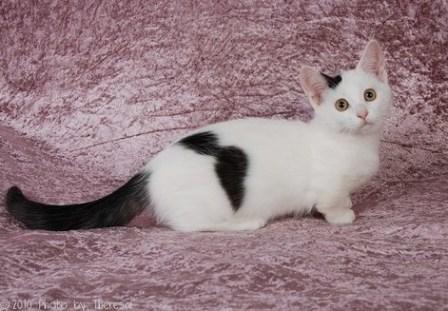
Karnaki Ek’s ‘n Dapper Muis | black Harlequin | Munchkin owned and bred by Karen Pepler | © Theresa Fouche
munchkin features and characteristics
The Munchkin has a medium sized body, broad shoulders, a rounded chest and the back slopes gently upwards from the shoulders to the tail.
Whilst the male is larger and heavier than the female, both have moderate to heavy boning and well developed muscles, but they are not bulky or compact.
The tail is moderately thick and tapers from the base to a rounded tip. When the Munchkin walks, it tends to carry its tail erect and high.
The distinguishing feature of the Munchkin is its short legs.
The hind legs are slightly longer than their front legs, but it's important to note that the upper and lower parts of the legs are equal in length.
The legs are medium boned and quite muscular.
Munchkins come in a standard short-legged cat and non-standard long-legged cat.
The short legs should not hamper the cat's survival ability nor should it hamper the cat's mobility.
Whilst some Munchkin cats may show some bowing of the long bones, the spine should not be affected.
Its head is described as a modified wedge, with contours that are rounded. The cheek bones are high, the chin is firm, the muzzle slender and the nose is of medium length.
Munchkins have a thick, moderately long and firm muscular neck.
The eyes are large, walnut-shaped, well spaced and expressive. All eye colors are accepted and there is no relationship between eye and the coat color.
The ears can be described as triangular in shape with a broad base and rounded tips.
coat variations
The Munchkin cat comes in two coat varieties and all coat colors and patterns.
The short-haired cat's coat has a medium undercoat and is semi-plush with a lustrous appearance.
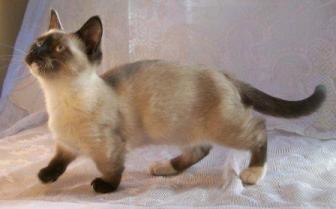
Shorthaired, seal point, Munchkin | © Kristin DuBois of Blue Sky Cats
The semi-longhaired cat's coat has a medium undercoat with a silky texture. The longer haired version also presents with a tail plume, britches and a ruff.
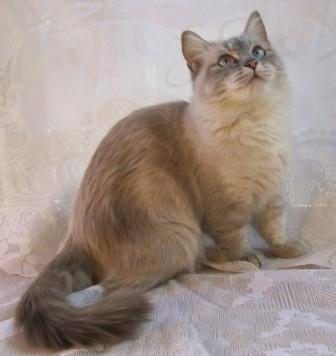
Semi-long haired, blue lynx point | Munchkin picture © Kristin DuBois of Blue Sky Cats
new dwarf cats are created
This miniature cat has captured the hearts and minds of many breeders.
Over the years, a number of 'designer cats' have been 'created' using this diminutive cat:
Napoleon cats, Minskin, Kinkalows, Skookums and more. Visit our dwarf cats page to find out more about these cats.
munchkin facts for potential owners
ideal home | ideal family
The Munchkin cat is suited to indoor living. They can venture outdoors provided that it is into an enclosed, escape-proof garden or a cat enclosure.
It is a great pet for children, but younger children need to be reminded that cats prefer gentle handling and that a cat's back legs must always be supported when they are carried. (This is to avoid undue pressure on the spine).
Munchkins accept and get along with other cats and relaxed 'cat-friendly' dogs.
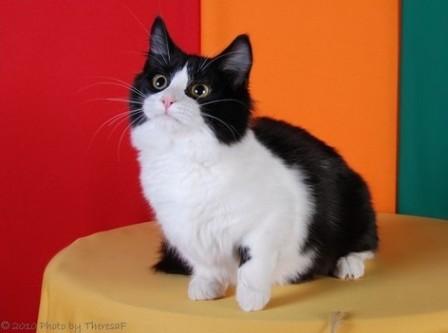
Karnaki Roll Over Beethoven | black and white bi-colour | owner V Wright, bred by K Pepler | Munchkin picture © Theresa Fouche
munchkin personality and temperament
The Munchkin cat will capture your heart!
This little cat retains its kitten-like qualities throughout its life.
Most owners tell us that what their Munchkin cat lacks in height it makes up in personality.
It is a sociable, affectionate and self assured cat that adores its owners.
Being active, lively and playful means they make ideal pets for children.
Whilst they are not great jumpers, they will find ingenious ways to find their way onto beds, furniture and a warm lap.
munchkin care
Munchkin cats are medium to low maintenance cat breeds.
The shorthaired version needs to be brushed once a week, whilst the longhaired version would benefit from a being brushed daily.
To assist you with cat grooming we have compiled extensive cat care tips.
munchkin health concerns
Whilst these cats are generally very healthy, they are susceptible to common feline infectious diseases which all cats need to be vaccinated against.
Some breeding lines are prone to lordosis (an inward curvature of the spine) and pectus excavatum (a deformity of the chest causing a sunken or funnel chest).
T.I.C.A (The International Cat Association) geneticist has described them as a 'physically sound' breed.
There have been very few cases of skeletal abnormalities reported. These are all rare conditions and by no means isolated to the Munchkin!
We recommend that you buy your kitten from a cat breeder who has a good record of breeding healthy kittens and we also suggest that you invest in medical cat insurance for your cat (and all pets).
diet | average weight of the munchkin cat
Like all cats, the Munchkin cat needs a well balanced diet. Cat nutrition and the choice of cat food are critical to the health of your feline companion.
It's also important that your cat has access to fresh, clean drinking water. Milk should be avoided as many cats are lactose intolerant.
Cat treats should be limited and only give your cat healthy treats!
The Average Weight
2.2 kg - 4.0 kg (4.9 lbs - 8.8 lbs). These are average weights for the Munchkin, males are generally heavier than the females.
life expectancy of the munchkin cat
Their average life expectancy is 9 + years which is considered a medium life span.
Many factors will determine the life expectancy of your cat - diet, exercise, general health, regular check-ups, vaccinations and deworming all play a part.
Related Pages:
Top of Munchkin Cat Page
Return to Domestic Cats
search our site
please like us
share our site
recommend on google
rare cats