Cornish Rex Cat
History and Development
The
Cornish Rex cat may resemble the statues seen in Ancient Egypt, but
experts say that this cat most certainly has its roots in England.
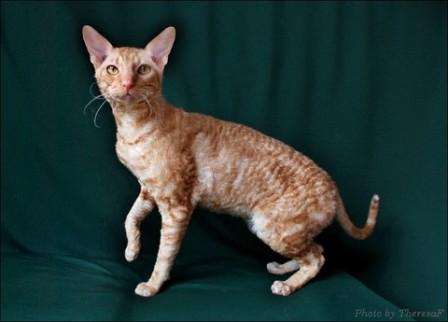
Mistbesque Wildfire Wildflames, red male, owned by Naomi Strydom and bred by Roeleen Bloemhof. Photo © Theresa Fouche
cat history starting in england
In 1950, a tortoiseshell and white house cat, named Serena, belonging to Ms Nina Ennismore of Cornwall, England gave birth to a litter of 5 kittens.
One of these kittens, a cream (some say red) male, had an unusual curly coat, large ears and foreign-type body with long legs.
He was named Kallibunker and he was unaware that he would become the foundation cat for a new cat breed.
It was on the advice of Ms Ennismore's vet that she consulted a geneticist to establish whether his wavy coat was due to environmental factors or due to a mutation.
The geneticist suggested that Kallibunker be bred back to his mother, Serena.
This union produced 3 kittens, all males. Two had curly coats and one had straight hair. Only the one curly-coated kitten survived, his name was Poldhu.
When two curly-coated cats were bred together, they produced only curly coated cats. This proved that it was a recessive gene that caused the curly-coated trait.
In subsequent breeding programs, the curly coated cats were bred to Siamese cats, Burmese cats and British Shorthair.
The aim of the inbreeding and outcrossing was to preserve the recessive mutation and to create genetic diversity (in other words, to increase the gene pool).
The new cat breed was named Cornish Rex - to celebrate the county in which the breed was founded and the 'Rex' after the curly-coated rexed rabbits discovered in France in 1919.
Despite the excitement around the discovery of this new mutation, the cat did not prove as successful as Ms Ennismore had hoped.
She
abandoned her breeding program in 1956 and sadly, both Kallibunker and
his mother, Serena were euthanized. (Pity homes could not be found for them!)
Another breeder, Brian Sterling Webb, took up where Ms Ennismore left off, but by this time only two male Cornish Rex Cats remained.
The breed was to say the least, endangered.
Poldhu (Kallibunker's son), who was a dilute tortie and white cat, produced healthy kittens that were sent to the United States in 1957.
These cats were to become the foundation cats of the American variety of the new cat breed.
Poldhu was unfortunately not destined for greatness! During a
routine procedure to obtain tissue samples for research, he was
'accidentally' castrated! (Remind me not to visit this surgeon).
Poldhu's son, Champagne Chas was left the unenviable task of 'keeping the breed alive'.
When the Devon Rex was discovered in 1969, it was hoped that the mutation was the same and that it could revitalize the Cornish Rex.
But the genes proved to be different - the cat from Cornwall had a gene called Gene I and the Devon Rex had Gene II.
With a now limited gene pool, out-breeding was inevitable. This resulted in the cat being less Oriental in type.
In 1965 a cat was introduced from Canadian stock to re-introduce the slender type. The cat breed finally received Championship Status at the GCCF in 1967.
cat history in the united states
Pendennis Castle, the son of Kallibunker and Lamorna Cove, the daughter of Poldhu were imported to California, US in 1957.
Francis Blanchen, the breeder, certainly got her monies worth - Lamorna Cove was impregnated by her father before her departure from the United Kingdom and gave birth to 4 beautiful kittens when she arrived in the US.
This signified the birth of the Cornish Rex in the US.
Unable to import any additional cats from the United Kingdom, due to a depleted breeding stock, Ms Blanchen had no other choice but to outcross her rexed cats to the American Shorthair cat, Havana Brown, Siamese and Burmese cats.
This also signified the move from the British breed standard and the development of the American breed standard.
Interestingly, a rexed cat, with the same mutation found in the Cornish was discovered in a Californian animal shelter in the 1960's. This little kitty was saved and brought into the breeding program.
The Cornish became very popular in the US and by 1964, the breed achieved full Championship status.
The German Rex was imported from Europe in 1961. Whilst it was recognized as a separate breed in Europe, in the US it was placed in the same class as the Cornish and this ultimately resulted in the demise of the German Rex breed in the United States. The German Rex is still a highly prized breed in Europe.
Related Pages:
Top of Cornish Rex Cat Page
Return to Types of Cats
search our site
please like us
share our site
recommend on google
rare cats