Birman Cats
Breed Profile and Facts
Birman cats are beautiful semi-longhaired cats with vivid blue eyes.
Experts believe
they originated in Burma or as it is now known, the Republic of the Union of
Myanmar situated in South East Asia. The origin and history of the Birman is shrouded in mystery so do take a look.
Nooitgedacht
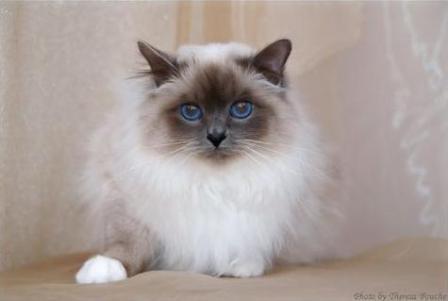
Engeltje | Blue Point Birman | Breeder and Owner: Sandy Gunst of
Nooitgedacht Birmans | photo © Theresa Fouche
features and characteristics
The Birman is a large, stocky cat.
Its torso is described as fairly long, sturdy with muscles that are firm and strong and a neck that is well muscled, strong and thick.
To complement the body, its legs are medium in length, muscular, heavily boned and strong. The Birman's tail is well furnished with long hair and is medium-long and carried upright.
The Birman has a large, round and broad head and this distinguished cat has a Roman-nose, prominent cheeks, firm chin and a well developed muzzle.
Its eyes are round and set well apart and the only accepted eye-color is blue and this should be a very deep, vivid blue.
a special coat
The Birman's coat is silky in texture and has no undercoat and this means it has a low propensity to matt. In certain instances, the fur on the stomach can be slightly curly.
The Birman cat is a pointed cat.
Color points include the tail, face (mask), the ears and the legs, but excludes the paws.
It has white 'gloves' on its front and back paws. On the back paws the white can extend up to the hock. All Birmans should have white feet.
The body coat-color should be even and the shading should be subtle, however, there should be a definite and strong contrast of color between the points and the body color.
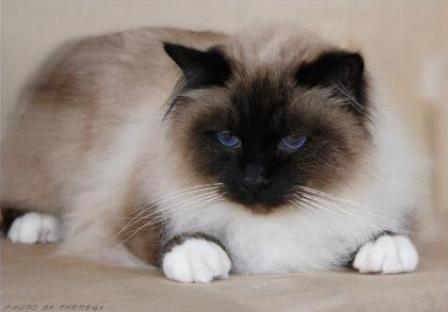
Timshay Corelli | Seal Point Birman | owned and bred Shirley Addison Wynne |photo © Theresa Fouche
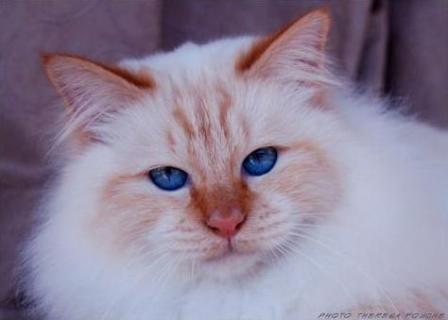
Sp Pr Quantox PumkinPye | Red Point Birman |owned by Shirley Addision Wynne | bred by Di Evans | photo © Theresa Fouche
birman information
ideal home | ideal family
Birman cats are by nature gentle and friendly cats which can be dangerous for a cat living outdoors.
These cats do adapt well to apartment and indoor living, but they do enjoy exploring outdoors too.
Create the ideal
environment for your cat - an enclosed, escape-proof garden or an indoor
adventure zone filled with toys, non-toxic plants, cat gyms and
scratching posts.
Would they make good pets for children?
Yes, they love children provided they aren't overly boisterous. Children need to be taught how to handle cats - they do not appreciate rough handling.
Will they adapt to other family pets?
Yes, they are sociable and appreciate an animal companion - dogs or
cats. Owners need to gradually introduce a new pet to the resident cats
or dogs and respect the rights of the existing pets.
birman personality
Birman cats are relaxed, gentle, docile, affectionate lap cats. These cats are calm and well balanced, in other words, not too placid or too exuberant.
Birmans are not quite as docile as Persian cats, so you can expect some activity.
They are quiet cats with soft 'bell-like' voices which they use sparingly and to have long conversations with you.
They can be quite playful and love to explore. They love playing with toys and it keeps them amused for hours.
Birmans are dignified cats who love to be told how beautiful they are! These cats are little 'purr machines' - a gentle touch will get them going.
As they are people-orientated cats, they get very attached to their owners and will follow them around the house just to be near them.
Whilst they prefer peace and quiet, this does not include solitude.
With this in mind, the ideal home for this cat would be a family with teenagers, the elderly or singles that are prepared to have two cats.
They are sociable cats and while they would happily be the 'only pet' they do prefer companionship.
They are excellent hunters and despite their appearance, are hardy athletic cats.
cat care
Birman cats are medium maintenance cat breeds.
They are easier to groom than other semi-or longhaired cats as they have no undercoat and are not prone to matting.
They are prone to hairballs, so they do need weekly grooming. Visit our grooming pages for complete cat hair care.
health concerns
Generally this is a healthy breed, but some cats may suffer from or are prone to one or two of these health problems:
- Azotaemia (a kidney problem)
- Distal axonopathy (neurological problem)
- Encephalomyelopathy (disease of the brain and spinal cord)
- Renal calculi (kidney stone)
- Thrombo embolism (blood clots)
Do consider cat health insurance for your cat and ensure that its feline vaccinations are up to date.
diet | average weight of the birman cat
Birman kitties are prone to obesity and hairballs.
There are special commercial diets that can assist in reducing hairballs and controlling weight.
It is important to keep your cat hydrated. Fresh, clean water should always be available to your cat.
The average weight is 4.5 - 8 kg (9.9 lbs - 17.6 lbs).
life expectancy of the birman cat
A cat living indoors that receives annual vaccinations, a well balanced diet and exercise, is expected to have an average life span of 15+ years.
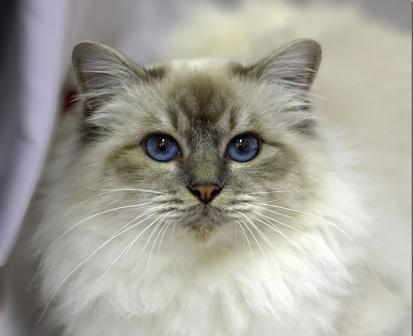
Super Trouper |Blue Tabby Point Birman | breeder and owner Sandy Gunst | Birman photo ©Irene McCullagh
Related Pages:
To Top of Birman Cats Page
Return to Domestic Cats
search our site
please like us
share our site
recommend on google
rare cats