Turkish Van Cat
Breed Profile and Facts
The
swimming cat or Turkish Van cat is a magnificent longhaired cat breed
that originated in Turkey many centuries ago. This is also known as one of the largest cat breeds.
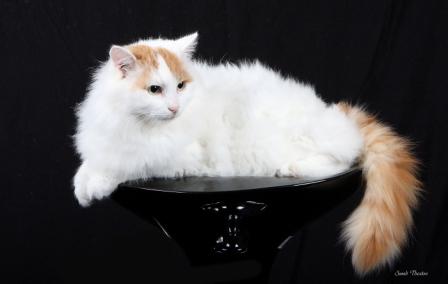
Turkish Van Lurkel | owner Rita Wiseman | © Sarah Thexton
turkish van characteristics
The Turkish Van is a medium long, sturdy and muscular cat with large bones.
Its legs are moderately muscular and long and the hind legs are longer than the forelegs.
The tail is long, thick and well furnished i.e. fluffy or plumed. The color of the hair on the tail should be even and extend down the full length of the tail and the hair on the tail is usually around 5 cm long.
The Van's head is medium to large and described as wedge-shaped. The head has gentle or rounded contours, prominent, high cheekbones and a medium length nose with a delicate stop. In profile the nose has a slight dip.
The muzzle is full and rounded and the whisker pinch considerable. Adult male cats often present with jowls.
The Turkish Van has medium large, round-tipped ears that are set well apart and are broad at the base and set high on its head.
It's important to note that breed standards for the eyes and coat differ between registries in the United States and the United Kingdom.
|
Cat Fanciers Association - USA |
Governing Council of the Cat Fancy - UK |
|
Turkish Van cats eyes are large, rounded, slightly drawn out at the corners and set at a slant. Eye color can be blue, amber or odd-eye. Their eyes should be clear, alert and expressive. |
Eyes are large, shaped like a peach or almond pit and set at a slant. Eyelids should be outlined in pink. Eye color: blue, amber or odd-eye (aka heterochromatic). |
the turkish van's coat
The Turkish Van cat has a long to semi-long coat.
There are two coat types:
- the English coat which is longer, furrier and
thicker and
- the Dutch coat which is slightly shorter, more even, soft and plush.
Both these coat types can be found in a single litter of kittens.
The hair is silky in texture (feels like cashmere) and there is no evidence of an undercoat. Generally, the coat is thicker in winter than in summer.
|
Cat Fanciers Association - USA The CFA accepts a white cat with Van pattern markings in Red, Cream, Blue, Tabby, Black and any version of these colors. Chocolate and Lilac colors and Pointed patterns are not permitted. The
CFA will allow color on the legs and body, provided it does not
distract from the van pattern and provided it is not on more than 20 %
of the body |
Governing Council of the Cat Fancy - UK The GCCF only accepts a white cat with Auburn or Cream Van pattern markings. No other colors are permitted. |
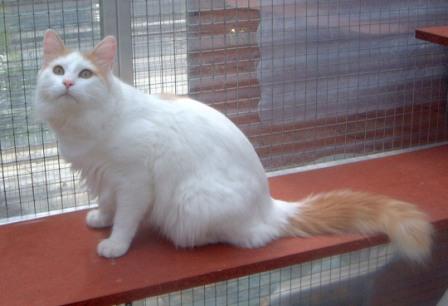
Cream Turkish Van | Tansdale Cattery Steve Lloyd
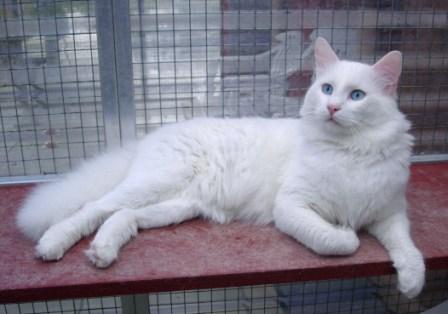
White Turkish Van | Vankedisi | Tansdale Cattery Steve Lloyd
An all-white Van is known as a Vankedisi.
Generally, however, the cat has cream (red, blue, tabby or black) symmetrical markings at the base of the ears. This must be separated by a blaze of white.
The second colored
patch runs from the tip of the tail to the croup. This color pattern
isolated to the head and tail is known as the van pattern.
turkish van facts
ideal home | ideal family
They prefer a safe, enclosed, escape-proof garden with a shallow pond.
They can adapt to apartment living provided that they have adequate space, toys and cat trees to climb.
Many breeders will insist that you enter into a contract that stipulates that your cat be kept indoors.
They are ideal companion cats who adore their humans and other animals.
They would suit a family with teenage children, rather than toddlers.
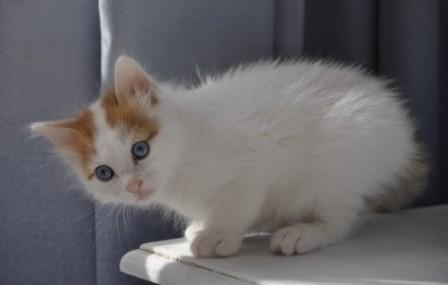
Turkish Van kitten owned by Mariska van Loggerenberg of Turiska Cattery
turkish van personality and temperament
The Turkish Van is a highly intelligent, resourceful and loyal cat.
There have been reports that describe the cat as 'aggressive' and this is not warranted.
The cat's temperament and personality is dependent on its upbringing. The kitten's character is largely dictated by the personality of the mother and the level of handling the cat receives as a kitten.
Selective breeding has resulted in the Turkish Van been a very affectionate, almost bordering on possessive, loving cat.
It is not a lap cat - it would rather sleep next to you than on top of you. It tends to bond with one or two members in the family.
The Turkish van is known to greet its owner with affectionate 'head butts' and 'love bites'.
Vans are sociable, and gregarious, but also very independent. It has unlimited energy and is a very lively, playful and friendly cat who enjoy family activities.
Vans are strong-willed cats that do not like to be picked up! It will come to you for petting and would prefer to be transported around the house on your shoulder rather than in your arms.
This is a breed that loves water and is often referred to as the Turkish Swimming Cat and enjoys games involving water.
Don't be surprised if your cat joins you in the shower or decides to have a drink of water from a faucet!
cat care
The Turkish Van cat is a medium-to-high maintenance breed.
As these cats have medium to long coats, daily grooming is recommended to keep their coat in tip-top condition.
Visit the chapter on cat hair care for great tips and advice for grooming longhaired cats.
turkish van health concerns
This ancient cat breed has no major health concerns, but please do vaccinate your cat against the common infectious feline diseases.
Veterinary costs can be expensive, so you should always consider cat insurance for your cat.
diet | average weight of the turkish van
To keep your cat fit and healthy you should feed it the best cat food possible.
To understand the importance of a well balanced diet we have compiled a guide to cat food and cat nutrition for your consideration.
The Average Weight
A healthy Turkish Van cat should weigh between 3.0 - 8.5 kg (7 - 19 lbs)
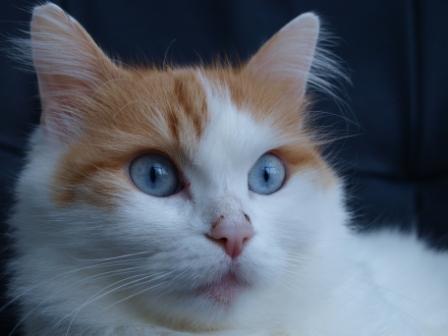
Ch Farfet Benim Lokum (Gaia) | blue-eyed auburn Turkish Van | owner Karen Guidera | breeder Marianne Upham of Yenicizgi Turkish Cats
life expectancy of the turkish van cat
If your Turkish Van cat enjoys a healthy lifestyle you can expect a life span of between 9 - 15 years.
Related Pages:
Top of Turkish Van Cat Page
Return to Domestic Cats
search our site
please like us
share our site
recommend on google
rare cats