Hairless Cat
The Ideal Home, Care and Possible Allergies
If you're looking for a hairless cat, then visit our chapter which provides a summary on the various hairless cats.
This chapter provides valuable information about their care, the ideal home for this high maintenance breed and we also explore potential health issues and whether they are hypo-allergenic.
ideal home
These cats are best suited to homes where the people have an absolute passion for the breed.
We say this, because these cats are high maintenance.
Hairless felines are exclusively indoor cats and as such require a home that is cat-friendly and has all the relevant cat furniture and toys to stimulate the cat and alleviate boredom.
To ensure their safety, many breeders insist that screens be installed on windows and doors to ensure an escape-proof environment.
As they are highly sociable and affectionate cat breeds, they do not tolerate solitude and would therefore not suit a home where the owners are away most of the day.
They are quite demanding in the grooming department and would need owners who have the time to do this. (see cat care below)
These unique and unusual kitties require the best, high quality food which may be financially restrictive.
If you feel that you qualify for one of these adorable felines, then be sure to seek a reputable cat breeder and avoid backyard breeders.
These
cats are in high demand which has led to an increase in 'kitten mills'
that offer sub-standard and unhealthy kittens.
cat care | grooming
fur protects
Cat hair and fur provides a protective barrier against skin irritation, extreme cold, sun, rain and injury from cat or dog fights.
Cat fur also has another important function - it distributes oils on the skin keeping the skin soft and supple. It absorbs any excess oils on the skin keeping the hair shiny and healthy.
cat care tips
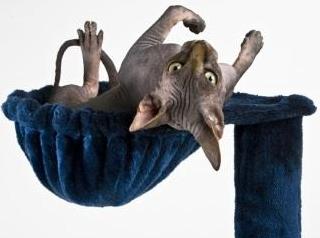
Cats absent of hair will naturally be more susceptible to skin related injuries and for this reason are best kept indoors.
Cats should only be allowed out between dawn and dusk to avoid sunburn.
Sun protection is critical for cats that are permitted outdoors during the day.
Feline sun block is available at pet shops and veterinary clinics.
In colder climates the hairless cat would need protection from extreme temperatures.
They will need fleecy lined jackets and bedding.
Igloo-type cat beds are ideal for cats lacking in the fur department.
They are not low maintenance cat breeds - in fact, they possibly require as much attention as the longhaired Persian.
Whilst grooming will depend on the type of coat, it is safe to say that your cat will require a bath every 2 - 3 weeks.
Between baths, they need to be wiped or sponged to remove any oil build-up on the skin and toes.
Their ears do produce excessive wax which needs to be cleaned daily.
Claw trimming is required every 2 weeks.
Never use a hairdryer on the skin as it may burn.
Use mild feline shampoos, some breeders do suggest a mild baby shampoo.
Do not prod in the ears with Q-tips (cotton buds).
Be careful not to bath your cat to often - over-grooming may result in dry skin and dermatitis.
hairless cat allergy
If you are allergic to cats, it is likely that you will be allergic to cats with or without fur.
Whilst cats with an absence of hair tend to cause fewer (hypo = low) allergic reactions (possibly due to a lower incidence of shedding and dander), they cannot be considered non-allergic.
We explore the 'science' of cat allergy in the chapter on hypoallergenic cats.
health problems
The hairless cat is generally a robust and healthy breed, but some lines do have hereditary diseases.
The Sphynx, for example can suffer from a genetic heart disease called hypertrophic cardiomyopathy (HCM).
Responsible breeders scan for this and exclude 'carriers' of the disease from their breeding programs.
Be sure to ask for this health certificate.
Skin cancer is obviously a concern and can be avoided with preventative care i.e. limited sun exposure.
It is reported that the Donskoy and Peterbald are prone to tooth decay and gum disease, so regular dental cleaning and check-ups are recommended.
Top of Page
Return to Hairless Cats
search our site
please like us
share our site
recommend on google
rare cats