Sphynx Cat
History and Origin
The Canadian Sphynx cat was not the first hairless cat to be discovered.
Mexican hairless cats date back to Pre-Columbian times (prior to 1500's) and even back to the Aztecs.
More recently however, hairless cats have been
documented in various places around the world. Let's take a look at the Sphynx history.
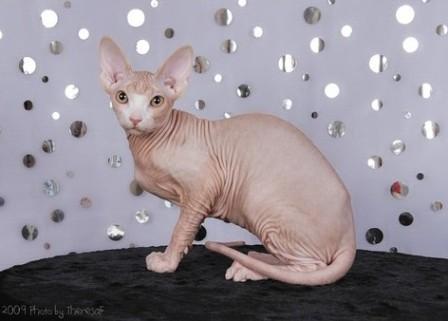
Spandau Aiko, red bi-colour Sphynx male kitten, owner Theresa Fouche, bred by Wilma Hyman
the hairless cat history
1938 France
Professor E Letard documented the mutant 'allele h' gene in two hairless kittens of Siamese cat breed parents.
1966 Canada
A Ms Micalwaith's female domestic shorthair cat gave birth to a hairless male kitten, aptly named Prune.
Prune and his mother Elizabeth produced further hairless kittens.
A breeding program was initiated and the CFA granted the breed provisional status. Sadly this was later withdrawn due to the high incidence of health problems.
1970 Netherlands
A breeding pair (descendants of Prune) were sent to Dr H
Hernandez where they were crossed with a Devon Rex cat - the purpose
being to further develop the breed.
1975 United States
Milt and Evelyn Pearson discovered a hairless kitten on their farm in Minnesota.
A year later this kitten was joined by another hairless kitten.
Both kittens (Dermis and Epidermis) were sold to Kim Mueske who tried unsuccessfully to breed hairless kittens.
A geneticist suggested she breed the female hairless cat back to her male off-spring.
As luck and genetics would have it, the result of this union produced 3 gorgeous hairless kittens.
1978 United States
Ms Gattenby, also of Minnesota, purchased hairless cats from the Pearson's and started her own hairless cat bloodline.
She then out crossed her cats with Devon Rex cats and then crossed them back to her hairless cats.
By doing this, she improved and developed the Sphynx which we know today.
Breeders continue to breed the Sphynx to shorthair cats and then back to hairless cats to create a genetically sound gene pool.
1978 Canada
A Ms Smith adopted 3 Canadian Sphynx cats, called Bambi, Punkie and Paloma - the modern Sphynx is also descended from these natural mutations.
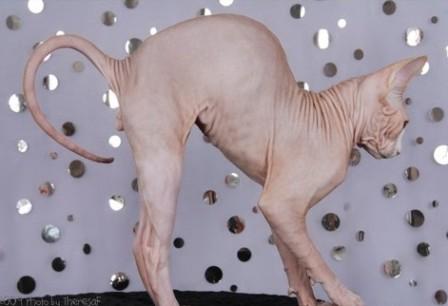
Spandau Aiko, red bi-colour Sphynx male kitten, owner Theresa Fouche, bred by Wilma Hyman
what causes the hairless trait
It is a spontaneous mutation which is caused by the recessive 'allele hr' gene.
Recessive means it can skip many generations before it once again comes to light.
Some people believe that it is a natural mutation that occurs in the cat population every 15 to 20 years.
The recessive gene
which causes hairlessness can apparently appear in almost any cat breed!
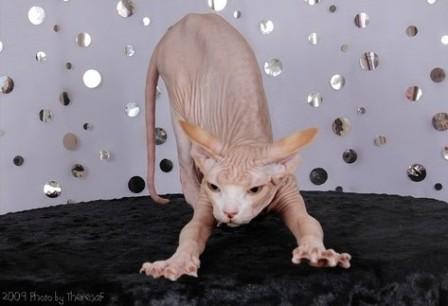
Spandau Aiko, red bi-colour Sphynx male kitten, owner Theresa Fouche, bred by Wilma Hyman
Related Pages:
Top of Sphynx Cat Page
Return to Types of Cats
search our site
please like us
share our site
recommend on google
rare cats