Siberian Cat
History and Cat Facts
The Siberian cat
is the the national cat of Russia. It was originally called the Sibirskaya Koshka. Some people call it the Siberian Forest Cat.
There is very little documented history of the exact origin of this semi-longhaired forest cat. It is believed they existed for centuries in the forests around Russia.
What is sure, is that this is a natural cat breed and man played no part
in its development.
history
These Forest Cats lived in extreme conditions in the wild where temperatures drop many degrees below zero.
They may have gravitated to animal herders in search of warmth and food and in an attempt to survive the very harsh winters and so became domesticated.
It is thought, that from here they developed as a result of crosses between this wild cat and domestic strays brought from the Ukraine and Siberia.
As it was against Russian law to own pets many of these cats survived in Russian monasteries.
Apart from been companion cats, they also acted as mousers and 'watch dogs', patrolling the open-beamed ceilings of the monasteries and keeping watch for unwanted intruders.
During the 1960's these cats were taken into homes in Moscow and St Petersburg (previously Leningrad).
Breeding commenced on a small scale, but this escalated in the 1980's.
In 1987 Betti and Hans Schultz imported two cats from St Petersburg to Belgium. It was a male cat named Tima and a red and white tabby female named Mussa.
The first Siberian Forest cats were brought to the United States in 1990 by Elizabeth Terrell of Starpoint Cattery.
By 1991 FiFe recognized the breed and TICA recognized the breed a year later in 1998. The CFA accepted the breed for registration in 2000.
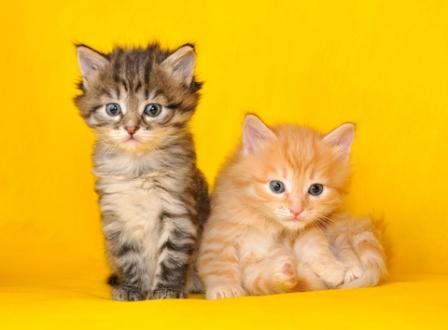
siberian forest cat description
The Siberian has been around for centuries and closely resembles the Norwegian Forest cat and the Maine Coon cat.
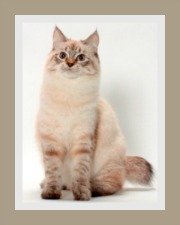
The Siberian cat has a semi-long to long triple coat and it varies from coarse to soft.
The insulating undercoat is thick and fluffy whilst the top coat is long and glossy. The hair may be slightly oily which effectively provides waterproofing.
This rich full coat effectively protects them from extreme, bitterly cold winters. (The coat is thicker in winter than summer).
All traditional colors and all color combinations are accepted, but strong colors and clear patterns are preferable.
The most common color is a golden tabby, with black pattern over a golden agouti.
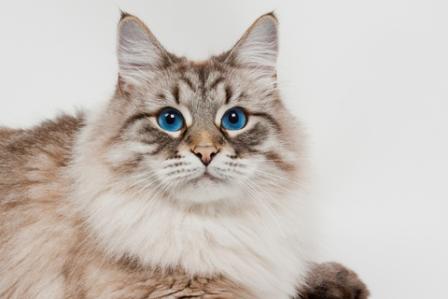
The Neva Masquerade is the name given to the colorpoint variety.
The colorpoint is believed to be an offshoot of the Siberian. It may have resulted from the introduction of the 'old-type' Siamese or from breeding with pointed stray cats living along the Neva River in St Petersburg.
Many Russian Siberian Forest cat breeders prefer to maintain the original colors and wild look of the breed - staying true to the original cat.
The Siberian is a large, compact and heavy cat, well muscled and powerful.
The
cat's legs are medium long, heavy boned and very muscular and the
hind legs are longer than the forelegs. It has a beautiful, well furnished, medium
length tail.
The head is described as medium-large, shaped like a modified wedge with rounded contours.
The Siberian's eyes are large, nearly round, open and expressive. Eye color has no relationship to coat color and ranges from copper to gold, to green gold.
The Neva
Masquerade has blue eyes.
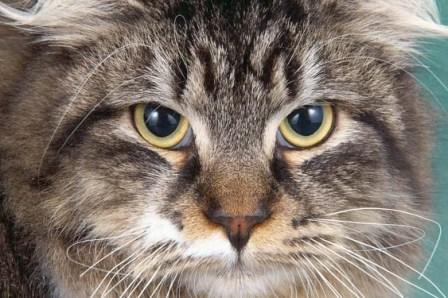
Sapphirensteel Ruslan, brown tabby and white owner| breeder Denise Burn © Robert Fox
hypoallergenic cat
Hypo-allergenic means low, less or below normal allergic reactions.
Fel D1 is a protein that is produced by sebaceous glands and found in cat saliva, skin and urine - it is this protein that causes allergic reactions in humans.
Most cats produce about 63,000 mcg of Fel D1 per gram whilst the Siberian cat produces about 200 micrograms (mcg) per gram.
Another reason may be that the Siberian has a thick, slightly oily, waterproof coat which results in less dry skin (dander) been produced and distributed around the home.
When cats groom themselves saliva mixes with dry skin cells (known as dander) and when this dries the cat will distribute the dander throughout the house and on furniture.
The breeders and owners we have chatted to maintain that they have
experienced low allergic reactions amongst allergy sufferers where their
cats are homed.
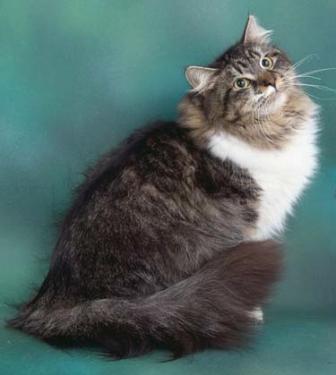
Sapphirensteel Ruslan, brown tabby and white owner| breeder Denise Burn © Robert Fox
info for potential siberian cat owners
ideal home
The Siberian cat is best suited to outdoor living, but by outdoors we mean an escape-proof, safe enclosed garden.
They can adapt to indoor living, but it's important to provide a suitable cat friendly environment for them.
personality and temperament
The Siberian cat is a playful, lively and active cat and is great with kids and despite its dominance, it is friendly to other cats.
This is a soft and gentle natured cat that makes a wonderful companion.
Owners describe it as dog-like and it loves to follow its owners around.
It is an affectionate cat that is equally at home on a warm lap as it is in the great outdoors.
It has a fascination with water and likes nothing more than dropping its much loved toys in pools of water. This cat is also an excellent climber and jumper and loves to run around.
The Siberian has a unique triple purr and makes chirping sounds.
cat care
This is a longhaired cat and bi-weekly grooming is recommended to keep the coat in tip-top condition.
During early Spring, additional grooming is required.
Its thick undercoat can become matted if neglected - especially the area under the armpits.
Visit our comprehensive cat care pages for great tips and guidelines on cat grooming, especially the page on hair care.
health concerns
Apart from common infectious cat diseases for which it can receive cat vaccinations, the Siberian Forest cat is a healthy cat breed. Cat health insurance is something you should consider for all your pets.
diet | average weight
The Siberian does have a tendency to gain weight and diet and feeding needs to be monitored.
There are commercial cat food brands for longhaired cats which the manufacturers claim reduces hairball.
Visit our cat food guide for information on a well balanced diet.
4.5 - 9.0 kg (9.9 - 19.8 lbs) is the average weight for Siberians. Male cats are heavier than the female cats.
life expectancy of the siberian cat
The Siberian has a medium-to-long life span of 12 + years.
Keep in mind that a cat that receives its vaccinations, a well balanced diet and lives indoors will live longer.
Related Pages:
Top of Siberian Cat Page
Return to Types of Cats > Domestic Cats
search our site
please like us
share our site
recommend on google
rare cats