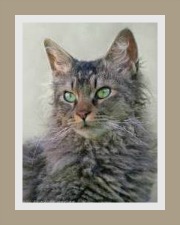
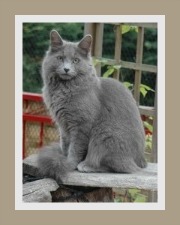
Manx Cat and Cymric Cat
Breed Profile and Facts
The Manx cat is a tailless cat and this feature is caused by a dominant autosomal gene (a natural genetic mutation).
This gene is also described as an incomplete dominant gene with varying effect and results in the Manx having no tail, a short stump or a full length tail.
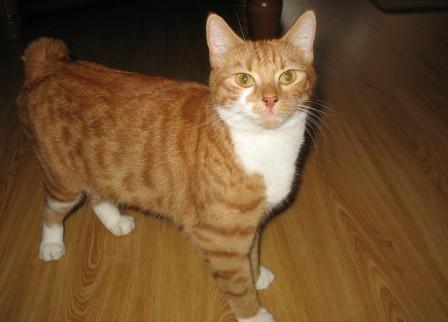
Picture of Manx courtesy of Gary Armitage of ManXilla cats
In this review we cover the Shorthaired Manx and Longhaired Cymric.
Essentially, the Cymric is the longhaired version of the Manx and as such, the same cat with a different name and the breed characteristics are the same apart from the coat length.
manx characteristics
At first glance the overall impression of the Manx and Cymric is one of roundness.
This is a compact cat that is fairly short-limbed and is amazingly heavy to lift.
The cat is slow to mature - it takes between 4.5 to 5 years for the cat to reach full maturity and the male cat is always larger than its female counterpart.
The Manx and Cymric both have a medium sized body
that is described as compact, well balanced and powerful and the
muscles are solid and the bones very sturdy.
The chest is broad and the neck is short and thick. Their backs are relatively short and arched from the shoulders to the rump and the rump is broad and round.
All these features accentuates the cat's roundness. Whilst the Cymric may appear longer, this is purely as a result of their longer coats.
The hind legs are longer than the front legs which results in the rump being much higher than the shoulders. The back legs are muscular, heavily boned and straight when viewed from behind.
The front legs are set well apart and are well muscled and sturdy boned. The paws are medium sized and round and the Cymric cat has tufts of hair between the toes.
The Manx has a round head that is slightly longer than it is broad. The cheekbones are prominent, the muzzle is longer than it is wide, the chin is strong and the whisker pads are rounded.
Its eyes are large and round and set at a slight slant, the outer edge of the eye being slightly higher. The color of the eyes should correspond to the coat color.
The ears are set wide apart and are medium-sized with rounded tips. The shorthaired cat has minimal furnishing on the ears, whilst the longhaired Cymric has full furnishing.
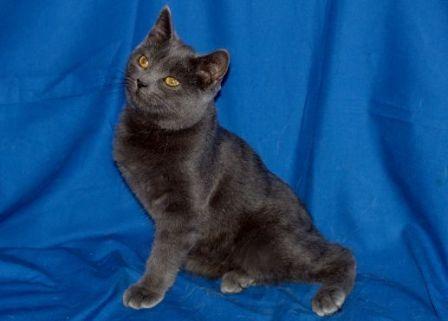
Manx photo courtesy of Claire Broughton of Shortontails Cattery in Vermont
the manx tail
The tail is the feature that differentiates this cat from other felines.
The
ideal Manx cat is tailless, but a slight rise in the bone or cartilage
at the end of the tail is allowed provided that it does not stop the
hand when the cat is being stroked.
There are 4 variations of the tail:
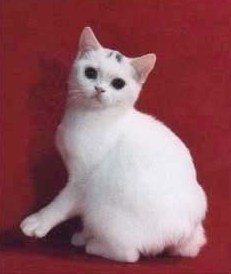
Ch Kelsha Riviera | white copper eyed rumpy | owner Kelly Tanner of Kelsha Manx | cat photo © Kelly Tanner | photographer: unknown
- A Rumpy which
by definition is a tailless cat. In fact all you will see or feel is a
depression or dimple at the base where the tail would normally be.
- Rumpy Riser has a short stub tail with no caudal vertebrae (i.e. the bones that make up a tail), there are 1 - 3 coccygeal vertebrae that are covered with clumps of fur.
- In the Stumpy, the tail is short and does have a couple of vertebrae that are generally curved or kinked.
- The Longy/Taily, as the name implies, is a cat that has a long tail as seen in the general cat population. There are breeders that dock these tails, but in some countries, tail docking is not permitted.
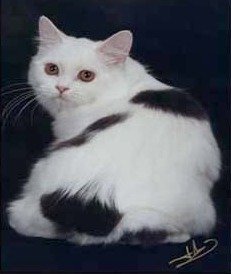
Ch Kelsha Loxahatchee | blue-white van Cymric rumpy riser | owner Kelly Tanner of Kelsha Manx | cat photo © Kelly Tanner | photographer: unknown
manx coat types
shorthaired manx cat
They have a dense, double coat. The texture of the coat may vary with coat color (white cats may be softer) and may display seasonal variations. (the coat is less dense in summer).
The outercoat and guard hairs may be slightly coarse and should be well padded, glossy and not close lying. The undercoat should be cottony, thick and close lying.
longhaired cat | cymric
The Cymric has a medium to semi-long coat. The coat is plush, but falls smoothly on the body.
The thick double coat has a silky texture. It has britches, full furnishing on the ears and tufts of hair between the
toes.
coat colors and patterns
In terms of coat color, Chocolate, Ticked tabby, Lavender and Pointed are not recognized colors and patterns.
TICA (The International Cat Association) however, does make an allowance for pointed versions.
Apart from the above, all colors and patterns are accepted.
The
coat colors are bold dramatic.
info for potential manx cat owners
ideal home | ideal family
The Manx cat is suited to outdoor or indoor living.
If you plan to keep your cat indoors (which is the safest place for it to be), you do need to create an environment which will alleviate boredom. So do invest in cat scratching posts, toys, cat gyms and edible plants.
Some breeders have contracts that stipulate that the cat must be kept indoors only.
When we say outdoors, we are really referring to an enclosed garden which is completely escape-proof. You may want to consider a kitty enclosure or cat run. This will give your cat the best of both worlds!
The Manx cat is ideal for families with children and other pets and make wonderful companions for the young and old.
Smaller children do need to be taught to be gentle with kittens.
Cats should always have their hind legs supported when held and this is especially so with the Manx.
Spayed/neutered cats get on well with all pets, cats and dogs.
manx personality and temperament
The Manx has an excellent even temperament.
It is described as a calm, gentle, affectionate and non-aggressive cat that is not hugely demanding.
An intelligent cat that is quick to learn and loves to play especially a good game of 'fetch'.
Being people-orientated it does not like to be left alone for extended periods.
The Manx is a talkative cat, but the good news is that it has a fairly quiet voice.
cat care
The Manx Cat with its short double coat requires minimal grooming.
The Longhaired Manx or Cymric has a semi-long, double coat and requires a daily brush.
The tailless or rumpy Manx may sometimes require a little extra attention around the anus as feces may cling to the short, close-lying fur in this area.
Need help with cat care? We have loads of valuable tips and guides for ultimate cat grooming.
manx health concerns
The Manx cat is generally considered a robust, healthy cat breed.
There are some hereditary / genetic conditions found in highly pedigreed animals and the Manx cat is no different.
During our research, we found numerous articles that refer to problems related to their taillessness, namely Manx Syndrome. If you need to know more about this condition then do visit the links provided to find out more about Manx Syndrome and Malformations.
You also need to be aware, that these cats have roamed the Isle of Man for over 300 years and whilst there may be some hereditary problems, many well-bred cats are free of genetic defects.
Our recommendation is that you buy your kitten from an experienced, knowledgeable, responsible and reputable cat breeder, one with an excellent track record of breeding healthy cats.
Also remember that all cats are susceptible to infectious feline diseases and require vaccination to prevent these killer diseases.
Do consider medical cat insurance for your cat.
diet | average weight of the manx cat
This kitty needs no specific or special diet. Good cat nutrition means good cat health. Our extensive information on cat food will provide you with options on the types of cat food.
Cats also need to have a plentiful supply of clean, fresh water.
Cat Weight:
The average weight for the Manx is 3.6 kg - 5.4 kg (8.0 - 12.0 lbs)
life expectancy of the manx cat
Their average life span is 12 + years. To find out how you can ensure that your cat lives a long and healthy life, visit the chapter on how long do cats live.
Related Cat Pages:
Top of Manx Cat Page
Return to Domestic Cats
search our site
please like us
share our site
recommend on google
rare cats