Japanese Bobtail Cats
Breed Profile and Facts
Japanese Bobtail cats are domestic cats that have the cutest bunny-type pompom tails. They are not tailless cats.
The short tail is due to a genetic mutation caused by a recessive autosomal gene.
In the early days, it was
believed that the Manx Cat and the Japanese Bob were related. This has
been disproved, the mutation that results in the tailless Manx is a
separate mutation.
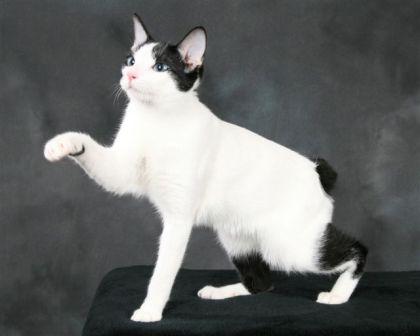
CFA Grand Champion Karol Abraham Lincoln | photo © Carol of Karol’s Cattery
features and characteristics
The Japanese Bobtail is a medium-sized cat with well developed muscles. It is slender and lean and certainly not flabby.
Its legs complement the body and are strong, long and slender, but not delicate or fragile.
the tail
The tail is its signature trait. Each cat has a clearly visible and unique tail - it can be curved, angled or straight.
The bone in the tail is rigid and strong except for the base of the tail.
The hair on the tail grows outwards in all directions and creates a pom-pom or 'bunny tail'.
When fully extended the tail can be 4 to 5 inches (10 - 13 cm) long.
The Japanese Bobtail has a triangular-shaped head, high cheekbones, broad muzzle and a long nose which in profile, has a gentle dip in it.
Its ears are quite large, set wide apart and they do tend to tilt slightly forward.
Eyes are large, wide-open and oval in shape and set at a slant. Eye color must be deep and vivid and correspond to coat color. Eye-color ranges from blue, green, odd-eyes and copper.
coat types and colors
Whilst Japanese Bobtail cats come in a variety of colors, the most sort after are the Bi-color and Tri-color cats.
The Mi-Ke is a tri-color consisting of black, reddish-brown and white and is the most prized color.
Irrespective of pattern, all colors must be clear, even and well marked.
Shorthaired
They have medium to short coats, with no noticeable undercoat. The hair should be soft and silky.
Longhaired
They have semi-long coats, with no noticeable undercoat. The hair should be soft and silky. The hair lies close to the body and they generally have ear and toe tufts and a frontal ruff.
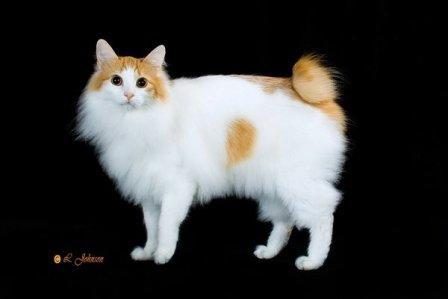
GPNW NuDawnz Kigenwotoru | longhaired | owned and bred by Lorna Friemoth Nu Dawnz Cattery | Japanese Bobtail picture | © Larry Johnson
japanese bobtail information
ideal home | ideal family
Japanese Bobtail cats are outdoor cats. Outdoor does not mean roaming the the neighborhood, but rather an safe, escape-proof garden or cat run.
Whilst they can adapt to apartment living, it is important to prevent boredom.
Creating an adventure zone for your indoor cat is a must. By this we mean an area filled with toys, scratching posts, cat gyms and areas to play hide-and-seek.
A single cat is a lonely cat, so do consider having two for company.
Would they suit a home with children?
Yes. Smaller children do need to be taught to be gentle with kittens and adult cats. Cats should always have their hind legs supported when held.
Are they pet friendly?
Yes - spayed/neutered cats get on well with all pets, cats and dogs. It's always best to supervise the introduction of a new pet. Do it gradually so that none of the pets feel threatened.
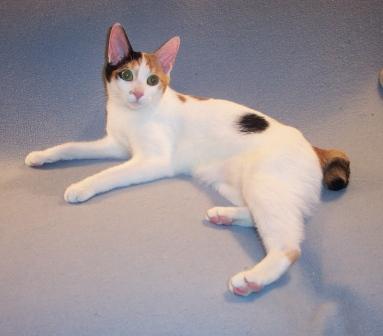
Kurisumasu Japanese Bobtails picture © Marianne Clark
personality and temperament
Japanese Bobtail cats are not for someone wanting a docile lap cat.
These are active cats that love exploring and are curious about their environment.
They are lively, sociable extroverts with strong personalities. You will never be lonely with one these cats as a companion.
They are very 'talkative' with a wide range of scales and tones in their voices. In many ways they are quite dog-like.
They love to carry toys in their mouth, play fetch and most of all they love to splash in water.
Whilst they could be described as very independent, this does not mean they don't need company. To the contrary, these cats are loving and affectionate and they adore human company. They do not tolerate solitude.
cat care
Whilst the longhaired version of the cat will require a daily brush, they are generally low maintenance cat breeds that require minimal grooming.
Shorthaired Japanese Bobtails are low maintenance cats. Their coats need to be brushed once a week. In Spring, they do shed more and require additional brushing.
For complete cat grooming advice visit our chapter on cat care
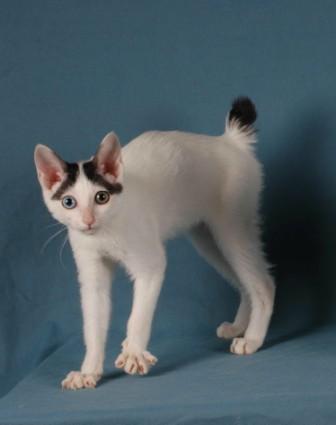
Kurisumasu Japanese Bobtails picture © Marianne Clark | cat: Bug CFA Grand Champion
health concerns
The Japanese Bobtail is a healthy cat breed.
Apart from the normal preventable infectious feline diseases that all cats are susceptible to this cat does not suffer from any genetic or hereditary diseases sometimes found in the tailless cats.
Always consider cat health insurance for your cat, you never know when it may be needed.
diet | average weight
No special diet is needed. Having said that, the longhaired version of the Japanese Bobtail may benefit from a special diet that reduces hairballs.
A well balanced diet and high quality cat food is essential - you need to decide which route to follow - kibbles, raw cat food or canned cat food.
Always ensure that your kitty has access to fresh, clean drinking water.
Average weight of Japanese Bobtail Cats
Males are generally heavier than the female cats. The average weight of these cats is between 2.5 kg - 4.0 kg (5.5 lbs - 8.8 lbs)
life expectancy
They have an average life expectancy of 12 + years.
Related Pages:
Top of Japanese Bobtail Cats Page
Return to Domestic Cats
search our site
please like us
share our site
recommend on google
rare cats