Cornish Rex Cat
Breed Profile and Cat Facts
The Cornish Rex cat is a domestic cat breed with a wavy-coat that originated in Cornwall England in 1950.
When the cats were exported to the United States in 1957 the breed was under threat and the gene pool was limited.
Once the cats arrived in the USA, American breeders were forced to outcross their Cornish cat to other cat breeds and this resulted in slight differences in the breed look, the most notable been the shape of the head and torso.
The breed is popular in the US but still remains a rare cat breed.
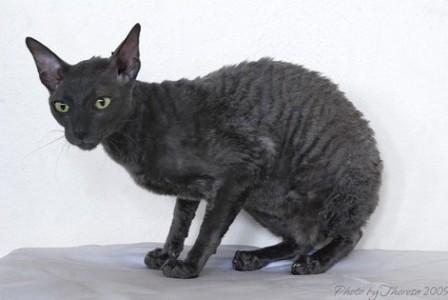
Roar'n Pure Mischief | Blue Cornish Rex | owners Lisa McGregor and K Gilson | bred by Rob and Karen Visagie |photo ©Theresa Fouche
a wavy coat
The Cornish Rex cat has uniform waves all over the body including the tail. The coat is wavy, short and dense, with no guard hairs.
The waves are named Marcel waves after a hairstyle of the 1920's.
The coat comes in a range of colors and patterns e.g. solid white, black, and red to tabbies, tortoiseshell, bi-color and pointed colors.
The pointed variety
is called a SI Rex.
different cornish rex features
britishThe British Cornish Rex cat's torso is small to medium in size, but long. Its back is very arched and the chest is full and deep. The bone structure is described as fine and the muscles, firm and powerful. |
americanThe American type also has a small to medium size body which is long and slender with a small waistline. |
|
The British Cornish Rex cat has a moderate wedge-shaped head (i.e. the length is greater than the width). Nose is straight - straight line from middle of the forehead to the nose tip. |
The American Cornish Rex has an egg-shaped head, Roman nose and prominent cheek bones. |
Both types of rexed cat breeds have long and slender legs that are well muscled. The paws are oval and dainty. The neck is slender and muscular and the tail slender and long and covered with wavy hair
The British and American type Cornish Rex have oval-shaped, medium to large eyes that slant slightly upwards.
The color of the eyes should be appropriate to the coat color and also be shiny, clear and the color intense.
Ears are large, wide at the base with rounded tips and covered with hair. The ears are erect and alert.
If you require a show quality cat, we recommend that you consult with the relevant cat registry in your country - find them here: all breeds of cats
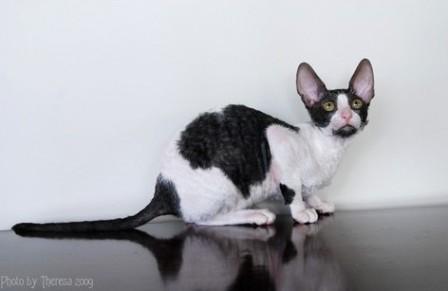
Mistbesque Robin | black harlequin Cornish Rex |Owner-breeder Roeleen Bloemhof | photo ©Theresa Fouche
hypoallergenic - fact or fiction
The term hypoallergenic is defined as been slightly or low in allergies, but certainly not 'non' allergic.
Many people believe that rexed and 'hairless' cats are hypoallergenic, but this is not entirely true.
Cats that are described as hypoallergenic do produce allergens.
Fel D1 is a protein responsible for causing the allergies. This protein is found on the skin, hair and saliva of cats. When a cat grooms itself, the old, dead skin cells referred to as dander, which contains Fel D1, is left on clothing, furniture and bedding and this causes the allergic response.
Knowing this, the type of coat would therefore have no affect on allergic reactions.
We have read that tests were conducted and it was
established that around 10 % of allergy sufferers can tolerate this wavy haired cat breed.
Our suggestion would be that before adopting any cat, that allergy sufferers visit the cattery, handle the cats and spend some time with their potential pet.
Animal shelters are littered with unwanted cats, so
prevention is better than cure.
info for potential owners
ideal home | ideal family
These are high energy pets that need lots of attention and will suit a home with children.
The Cornish Rex cat is best suited to indoor living.
It's important to create an adventure zone for your indoor cat to alleviate boredom. Many cat breeders have contracts that stipulate that the cat must be kept indoors only.
If your cat is allowed outdoors, it must be an escape-proof garden.
Would they suit a home with children?
Yes, they adore the company of children. Gentle play should always be encouraged
Are they pet friendly?
Yes - they get on well with other cats and dogs
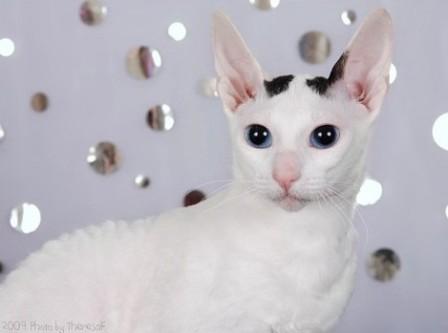
Mistbesque Sweetpurrs Ceylon | black van cornish rex | owner Roeleen Bloemhof, | breeder H Saaro | photo ©Theresa Fouche
personality and temperament
Having these cats in your life means you'll be entertained for hours.
They are lively acrobats and retain their clownish, kitten-like personalities into adulthood.
They are playful and energetic and love fun games like fetch.
These cats are highly sociable cats and detest been left alone. Solitude is just not for them! They adore their humans and are very affectionate, gentle and loving.
They are always in motion, but when they do settle for a moment, they are wonderful lap cats. In fact they love warm places to curl up in.
This breed can be quite demanding and their voices can be loud and harsh when they need attention, but they are generally quiet.
cat care
All cats produce oils that nourish the skin and hair.
The Cornish has short, wavy hair that generally does not absorb these oils as much as cats that have a longer and denser coat.
These oils tend to accumulate, making the fur oily and this in turn attracts dirt and grit.
This means that your cat will require frequent bathing.
It is also important not to over-groom your cat - a weekly very gentle brush (in the direction of the hair growth) is all that is required.
For more information on cat care take a look at our comprehensive pages.
health concerns
Generally the Cornish Rex is considered a healthy breed.
Breeders have told us that potential owners need to be aware of the following:
- They are prone to gingivitis (gum disease), which is quite common in many cat breeds, so dental hygiene is important.
- Hypertrophic cardiomyopathy (heart defect) has been
noted in some Cornish Rexes. This is a common heart disease amongst
certain cat breeds and can be screened for.
- Blood type incompatibility amongst breeding cats
which results in the death of kittens. Reputable cat breeders do screen
for this.
An annual visit to the vet for vaccinations, regular de-worming and dental hygiene and a good quality diet is all that's needed.
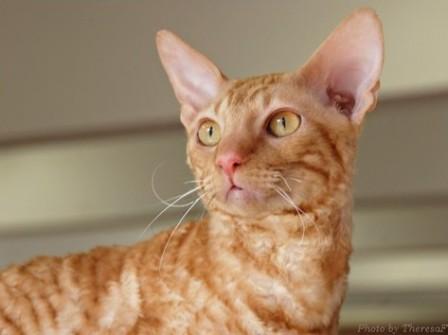
Mistbesque Wildfire Wildflames, red male, owned by Naomi Strydom and bred by Roeleen Bloemhof. Photo © Theresa Fouche
diet | average weight
The Cornish Rex has a very good appetite, so you will need to watch your cat's weight.
You need to purchase the best cat food you can afford. As a pet owner you have the choice of feeding your cat a raw diet, canned cat food or dry kibbles or a combination of the three.
Avoid cow's milk in you kitties diet - cat's drink water!
Cornish Rex cat breed weight?
Males are larger than the female cats. The average weight of this domestic cat breed is: 2.5 - 4.5 kg (5.5 - 9.9 lbs)
life expectancy
These cats have an average life span of 12 + years. A number of factors will the determine your cats life expectancy. Find out more about this in our chapter on how long do cats live.
Related Pages:
Top of Cornish Rex Cat Page
Return to Domestic Cats
search our site
please like us
share our site
recommend on google
rare cats