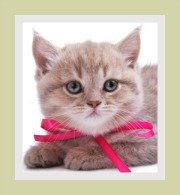
Cat Hair Care
Grooming Long and Shorthaired Cats
Cat hair care is important throughout the year.
Whilst cats lose hair daily, there will be periods when they shed more hair and where additional brushing is required.
Whilst cats do a great job of cleaning themselves, some human intervention is still required.
advantages:
- Frequent brushing keeps the fur in good condition.
- It removes dirt
and grit and allows you to check your cat for external parasites like
ticks, fleas and mites.
- Removing excess hair also means that your cat will ingest less hair.
This reduces the chances of your cat ingesting hair and getting
hairball.
- Regular brushing reduces the amount of hair shed on bedding and furniture.
grooming longhaired cats | 10 easy steps
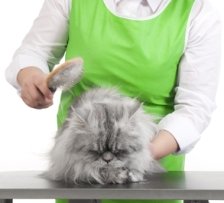
This section includes Persian cat hair care and all longhaired cats particular those with a dense undercoat.
step 1
Organize yourself!
Ensure that you have the necessary cat grooming tools close at hand and that both of you are calm and relaxed.
step 2
Using a firm bristle brush start on the back and gently brush the coat from the head to the base of the tail.
Make sure that all loose hair is removed.
tips:
- Brush your cat's coat in the direction of the hair growth.
- Do not pull or tug at the knots
- If your cat becomes uncomfortable or irritated - stop grooming
step 3
Sprinkle some grooming powder onto the fur and work it into the fur with your fingertips.
Unscented grooming talcum powder will absorb oils and separate the hair allowing you to tease out any tangles, matting or knots.
step 4
Using the wide-toothed metal comb, gently comb through the fur.
Comb the fur right down to the roots.
step 5
Severe matting is uncomfortable and must be removed.
If brushing and combing doesn't do the trick, then use the round-ended scissors to cut the knot out.
Be very careful not to nip your cat's skin.
A simple way to avoid cutting your cat is to gently ease the wire comb under the matting close to the skin thereby forming a barrier between the skin and the scissors.
This will allow you to remove the knot without injuring your cat.
Severe matting may mean that the cat will require professional clipping.
Clipped cats cannot be exhibited at shows.
step 6
Grit, fine dust, dirt, skin flakes and parasite eggs can be removed by using the fine-toothed metal comb.
step 7
Once the back is done, you can repeat steps 1 - 6 on the underside (tummy) and tail.
Pay special attention to those areas prone to extensive matting, like the inner thighs, armpits, neck and chin area.
Gently brush the tail as it is extremely sensitive.
Pay special attention to the fur around the anus as this area is prone to clumping with feces.
step 8
Brush out any clumping of fur tufts on the paws and between the toes.
step 9
You will need to use a large 'human' toothbrush to get to those small, difficult to reach areas like the hair around the eyes, ears, cheeks and nose.
step 10
Finally, brush out any excess powder and then run the grooming glove (or chamois leather cloth) over the fur to ensure a smooth, shiny and soft coat.
...and that's perfectly pampered cat hair care!
cat hair care for shorthaired cats
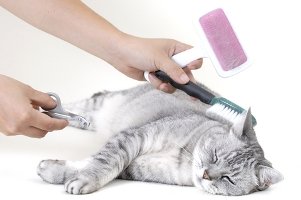
Grooming short-haired cats is relatively quick and easy.
A light brush will loosen dead hair and thereafter, all you will need to do is run a fine-toothed comb through the fur which will lift and remove any loose hair, grit and parasites.
You can end-off kitties grooming using a cat grooming glove to smooth and shine the coat.
Running a silk scarf over the coat will also give your cat's coat a lovely shine.
That's shorthair cat care in a jiffy!
TIP
Over the years, we have had many shorthaired cats.
A quick and easy way to remove loose hair is to moisten your hands with water and run them over the cat's fur.
Simply rinse your hands and repeat if necessary.
It works a like a dream!
clipping and shaving longhaired cats
Persian cat care (in fact all longhaired cats) should not involve shaving or stripping the cat of fur.
The fur protects the cat from extreme heat and cold and prevents injury as the fur acts as a barrier.
Having said this, there may be times when you will have no alternative but to remove or 'cut back' the fur.
Clipping or stripping may be required if your cat's fur becomes severely matted. (Sadly, this is generally due to neglect - see below)
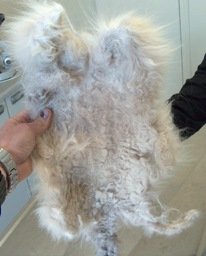
matted fur removed from a Persian cat
Clipping is best left to the experts, a reputable cat grooming parlor or your local veterinarian may offer this service.
Unless your cat is accustomed to being shaved, it may require sedation, in which case, a trained professional should be asked to perform the procedure.
The 'poodle'or 'lion cut' is the most popular clipping style which entails removing old fur on the body, leaving hair on the head, tail and legs untouched.
To prevent clumping or feces sticking to the fur around the anus, many owners do clip the fur around this area for hygiene purposes. This may be referred to as the 'hygiene-clip' or sanitary clip.
Some cat owners prefer a partial clip which entails clipping those problem areas i.e. armpits, inner thighs, under the chin and tail, leaving all the fur on the back, the sides and the tail.
Note:
Cats that are allowed to free-roam or live in warm climates are sometimes stripped of all fur.
It makes it easier for the owner to manage their cat's coat.
It must be remembered that if this is done, your cat will find it difficult to regulate its body temperature.
You will need to keep a watchful eye on your cat for signs of hypothermia (low temperature), or sunburn.
A stripped cat is a most unattractive cat and the cat tends to feel embarrassed!
Cat hair care is easier if your cat is kept indoors.
Note:
During Spring and Autumn your cat will molt (shed additional hair) and will therefore require additional cat hair care during this time.
Related Pages:
Top of Cat Hair Care Page
Return to Cat Care
search our site
please like us
share our site
recommend on google
popular pages